


So let me begin by asking you a question. Have you ever considered clothing as a category of chemical exposure? Have you ever thought about the chemical composition of the intimate wear you buy? I think most of us have never asked these questions. Because clothing is rarely thought of as something that can expose us to chemicals, let alone something that might affect our health.
Well, let me burst that bubble for you. Majority of fashion brands have been called out for adding chemicals in their clothes. And this list does not stop at ultra-fast fashion brands like Shein. It includes some names that many here might have used at some point. Lululemon, Addidas, Patagonia, Athleta, Alo and more… all have all been found to have significant levels of forever chemicals in them [1][2][3].
Harmful substances like Per- and polyfluoroalkyl substances (PFAS), popularly known as “forever chemicals”, along with bisphenol A (BPA), phthalates, and heavy metals are all found in garments from leading fashion brands. Chemicals are added in clothes mainly in the dyeing and finishing processes of manufacturing. These processes and chemicals make clothes stain resistance, water resistance, wrinkle resistance, add durability, in addition to other functions.
We have all encountered clothes with these properties. But many have never questioned if these items can make us sick. The answer is yes, it can, and I will get to the health impacts later in the essay. But before that, let me point out why it is a bigger problem than just chemicals in clothes.
Chemicals are also added in intimate wear products like underwear, period underwear, bras, in addition to other clothes. And intimate wear sits against our bodies for extended periods of time. This makes dermal exposure, or exposure through the skin, an important part of the conversation. Chemicals present in textiles can migrate from fabrics and, depending on the chemical and conditions, potentially be absorbed through the skin. And that makes intimate wear a critical site of inquiry, particularly because chemical burdens and their consequences are not necessarily distributed equally across consumers.
We read the labels on personal care products, skincare and food. Why not hold clothes and underwear, which sits against our body 24/7 to the same level of scrutiny?
Here is the truth.
Fashion brands are not required to hand you a complete chemical history of the garment you are buying.
And this lack of transparency does not exist in a vacuum. Fashion has been scrutinized for decades for labor exploitation, child labor, low wages, and unsafe working conditions. The industry’s business model has repeatedly shown what happens when speed, volume, and low prices are prioritized while the harms created elsewhere in the system remain largely invisible. Chemical safety belongs in that same conversation.
So chemical safety is not part of the fashion industry by design!
And here is the kicker. Chemical burdens on bodies is not something that is happening now. Garment workers involved in dyeing, finishing, and textile production have faced occupational chemical exposures for decades. What is changing is that we are beginning to ask more seriously what happens at the other end of the supply chain when these impacts show up for people wearing it too.
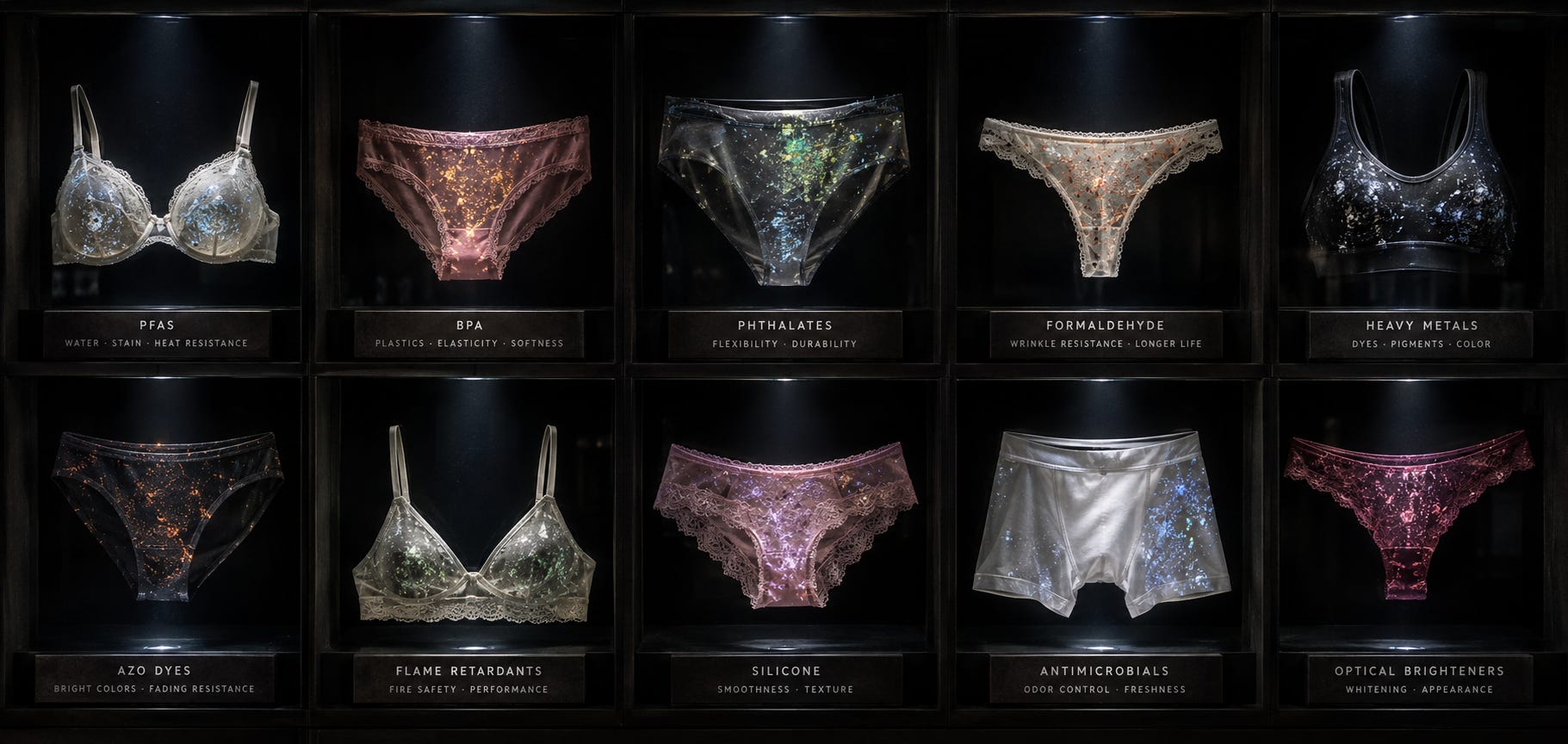
What we need to know and do not know about health impacts from PFAS?
Let me begin with the anatomy of the name “forever chemicals,” or PFAS. They get that name because PFAS contains an exceptionally strong carbon fluorine bond, which makes them highly resistant to breaking down. And therefore persist FOREVER. As a result, they become bioaccumulating, i.e., they accumulate in environments and bodies without breaking down. This makes it not only an environmental concern, but also a public health one.
So what does that actually mean for health?
Here are some science backed health impacts of PFAS exposure and why we need to take this more seriously.
1. Reproductive hormones and fertility
PFAS, BPA, and phthalates have all been studied as endocrine disrupting chemicals, meaning they can interfere with the hormonal systems that regulate processes like reproduction. Research has linked exposure to changes in reproductive hormones, infertility, and adverse pregnancy outcomes [4][5][6][7].
2. PCOS and reproductive health
Endocrine disruption due to PFAS has also been linked to increased risk of Polycystic Ovarian Syndrome (PCOS) related infertility [8].
3. Ovarian function
There is evidence of endocrine disrupting chemicals being associated with ovarian disorders, diminishing ovarian reserve and changes in endogenous hormones development [9].
4. Broader health effects
Epidemiological studies have revealed association of PFAS exposure with a variety of health effects like altered immune and thyroid function, lipid and insulin dysregulation, adverse reproductive and development outcomes [10].
There is no shortage of evidence showing that PFAS and other chemicals can have serious health implications. But the question I want to stay with here is more specific: what does any of this have to do with intimate wear, and what does it reveal about the broader fashion system?
How is PFAS associated with Intimate wear and exposure ?
The concern becomes harder to ignore when we move from clothing in general to intimate wear. Underwear, bras, and menstrual products sit against some of the most sensitive parts of the body for hours at a time, creating the possibility of prolonged exposure to whatever chemicals may be present in the fabric, dyes, finishes, or treatments.
I focus on intimate wear here because it is not an optional category of fashion. It is something most of us use every day, and access to it should not require us to make tradeoffs between affordability, function, and health. Much of the research on chemicals in textiles looks at clothing broadly, but intimate apparel deserves particular attention precisely because of how closely and continuously it interacts with the body.
And there is already reason to look more closely because recent studies make the concern more concrete. A study that tested 59 feminine hygiene products found that period underwear and reusable pads had the highest rates of intentional PFAS use, with elevated total fluorine detected in 33% of period underwear and 25% of reusable pads [11]. Another 2025 study tested three menstrual underwear products and one non-menstrual organic cotton control. At least one target PFAS showed up in every garment layer they tested. In total, they detected 20 different PFAS across the garments, including in the crotch layers [12]. Research examining roughly 120 women’s undergarments found elevated levels of heavy metals including aluminum, zinc, and iron [13]. A related study also detected chemical additive containing heavy metals in women’s underwear and bras and identified potential carcinogenic risks associated with some of those exposures [14].
Even the popular period underwear brand Thinx faced a class action lawsuit after marketing itself around safety and sustainability while independent testing detected PFAS in its products. What is striking is that the legal case centered on misleading marketing claims, rather than the chemistry of the product itself [15][16].
So brands might market themselves as sustainable, but testing might highlight a different outcome.
Why the consumer is almost completely in the dark ?
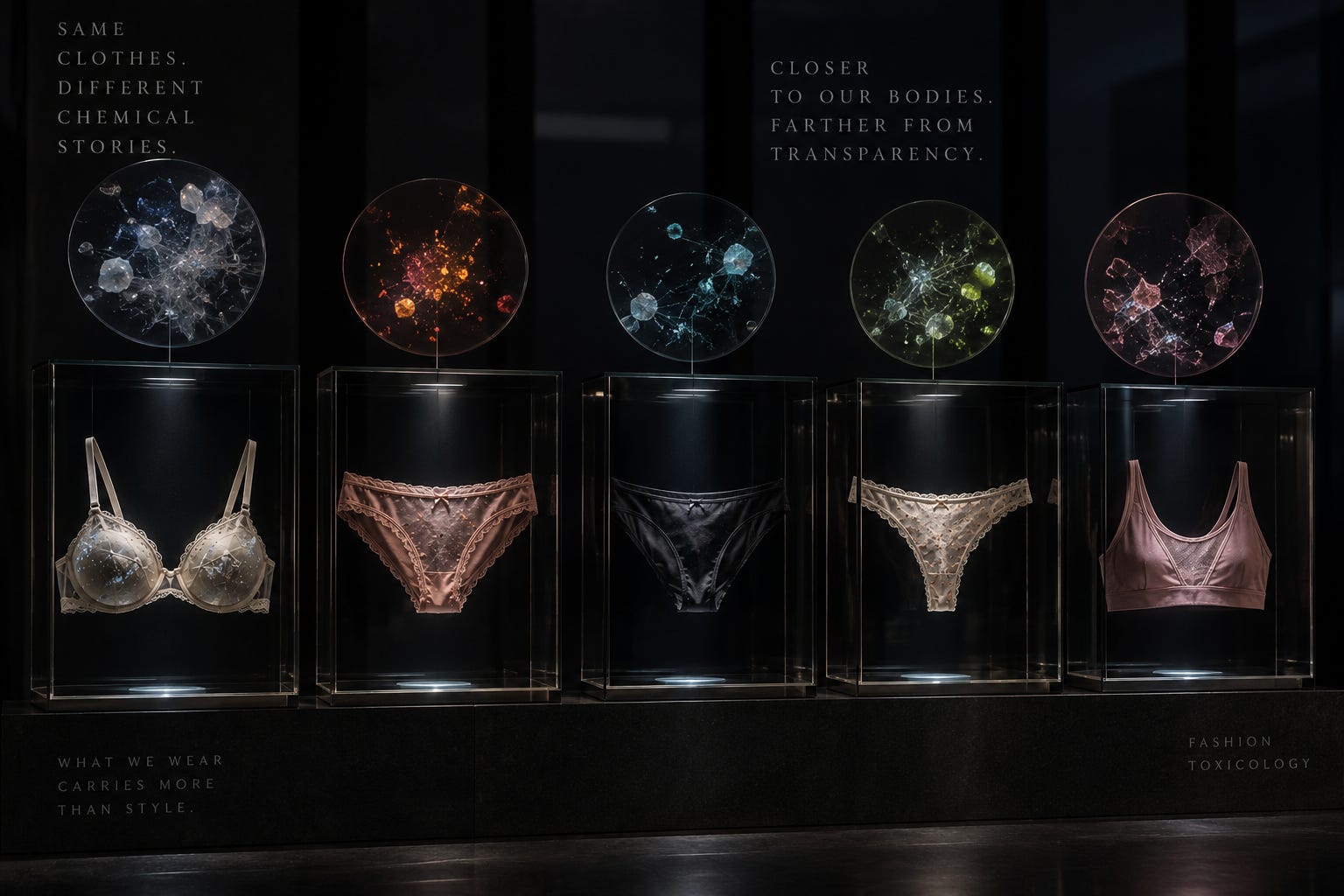
What makes this especially unsettling is not simply that these chemicals may be present. It is how little the average person is told about them. Clothing labels tell us fiber composition, size, care instructions, and country of origin, but generally do not tell us what chemical treatments or finishing agents were used. So even a highly motivated consumer may have no practical way to know what they are being exposed to.
A clothing label can tell you that something is 95 percent cotton and 5 percent elastane, but it tells you almost nothing about the chemical treatments that helped turn those fibers into the garment you are wearing.
And this where I turn toward the broader system at play. So here is the thing that many sustainability creators, public speakers and even some educators rarely touch upon. And that is majority of the production takes place in the Global South, where regulatory systems, enforcement capacity, and manufacturing conditions differ. Regulations in major consumer markets do not simply translate into the factories producing clothes in China, India, Vietnam, Sri Lanka, and elsewhere.
Additionally, this production model is one reason major brands have been able to provide consumers with cheap clothes at such low prices. Production is outsourced to regions where labor is cheaper, manufacturers operate under intense pricing and delivery pressure, and workers and communities often absorb the costs that remain invisible at the point of sale [17]. Chemical use, cheap dyes, limited disclosure, and weak transparency become part of this larger system because producing cleaner, safer products can require more investment, stronger oversight, and greater accountability across the supply chain.
Therefore, I argue that the structure of the fashion industry was never really built to engage with safety. Weather it is safety of people who are making it, or people who are consuming it. Safety has too often been treated as secondary to speed, cost, and volume.
There is currently no comprehensive regulatory requirement to push for better labeling of clothes beyond just composition and actually trace chemicals throughout the supply chain. Additionally, many emerging chemical restrictions focus on what can be sold in a market, rather than what happens at the point of production. So even when regulation exists, there can still be a major gap between the point of origin and the point of sale.
And this is where I want to leave you with a dilemma that all of us need to sit with. Things that seem harmless do not necessarily mean they are. We need to be able to see past the illusion of viewing clothes only as something that is fashionable and fits into an “aesthetic”. It can carry chemical burdens, labor exploitation, and health consequences for both people who wear and make them.
See you in the next post! And that one will be about how chemical burdens are not equal for everyone.
Works Cited:
[1] Difrisco, E. (2022). New Testing Shows High Levels of BPA in Sports Bras and Athletic Shirts. Center for Environmental Health. https://ceh.org/latest/press-releases/new-testing-shows-high-levels-of-bpa-in-sports-bras-and-athletic-shirts/
[2] Environmental Health News. (2022). Investigation finds evidence of PFAS in workout and yoga pants—EHN. https://www.ehn.org/pfas-clothing
[3] Segedie, L. (2022, January 19). Non-Toxic Activewear Guide: “Forever Chemicals” in Workout Leggings. MAMAVATION. https://mamavation.com/product-investigations/non-toxic-activewear-guide-pfas-workout-leggings-yoga-pants.html
[4] Aguirre, E. (2022). Endocrine Disrupting Chemical Exposure in Feminine Hygiene Products and the Effect on the Menstrual Cycle. Master’s Projects and Capstones. https://repository.usfca.edu/capstone/1399
[5] Cohen, N. J., Yao, M., Midya, V., India-Aldana, S., Mouzica, T., Andra, S. S., Narasimhan, S., Meher, A. K., Arora, M., Chan, J. K. Y., Chan, S.-Y., Loy, S. L., Minguez-Alarcon, L., Oulhote, Y., Huang, J., & Valvi, D. (2023). Exposure to Perfluoroalkyl Substances and Women’s Fertility Outcomes in a Singaporean Population-based Preconception Cohort. The Science of the Total Environment, 873, 162267. https://doi.org/10.1016/j.scitotenv.2023.162267
[6] Durosko, E. (2023). Death by Fashion: Consumers Face Health Risks By Purchasing From Unregulated Fast Fashion Brands. Loyola Consumer Law Review.
[7] Qu, R., Wang, J., Li, X., Zhang, Y., Yin, T., & Yang, P. (2024). Per- and Polyfluoroalkyl Substances (PFAS) Affect Female Reproductive Health: Epidemiological Evidence and Underlying Mechanisms. Toxics, 12(9), Article 9. https://doi.org/10.3390/toxics12090678
[8] Wang, W., Zhou, W., Wu, S., Liang, F., Li, Y., Zhang, J., Cui, L., Feng, Y., & Wang, Y. (2019). Perfluoroalkyl substances exposure and risk of polycystic ovarian syndrome related infertility in Chinese women. Environmental Pollution, 247, 824–831. https://doi.org/10.1016/j.envpol.2019.01.039
[9] Duursen, M. B. M. van, Boberg, J., Christiansen, S., Connolly, L., Damdimopoulou, P., Filis, P., Fowler, P. A., Gadella, B. M., Holte, J., Jääger, K., Johansson, H. K. L., Li, T., Mazaud-Guittot, S., Parent, A.-S., Salumets, A., Soto, A. M., Svingen, T., Velthut-Meikas, A., Wedebye, E. B., … Berg, M. van den. (2020). Safeguarding Female Reproductive Health against Endocrine Disrupting Chemicals-The FREIA Project. International Journal of Molecular Sciences, 21(9), 3215. https://doi.org/10.3390/ijms21093215
[10] Fenton, S. E., Ducatman, A., Boobis, A., DeWitt, J. C., Lau, C., Ng, C., Smith, J. S., & Roberts, S. M. (2021). Per‐ and Polyfluoroalkyl Substance Toxicity and Human Health Review: Current State of Knowledge and Strategies for Informing Future Research. Environmental Toxicology and Chemistry, 40(3), 606–630. https://doi.org/10.1002/etc.4890
[11] Wicks, A., Brady, S., Whitehead, H. D., Hedman, T., Zachritz, A., Venier, M., & Peaslee, G. F. (2025). Per- and Polyfluoroalkyl Substances in Reusable Feminine Hygiene Products. Environmental Science & Technology Letters, 12(8), 924–929. https://doi.org/10.1021/acs.estlett.5c00553
[12] Good, S., & Charbonnet, J. A. (2025). Extractable Per- and Polyfluoroalkyl Substances in Menstrual Underwear. Environmental Engineering Science, 42(3), 137–140. https://doi.org/10.1089/ees.2024.0270
[13] Nguyen, T., & Saleh, M. A. (2017). Exposure of women to trace elements through the skin by direct contact with underwear clothing. Journal of Environmental Science and Health, Part A, 52(1), 1–6. https://doi.org/10.1080/10934529.2016.1221212
[14] Chen, H., Cheng, J., Li, Y., Li, Y., Wang, J., & Tang, Z. (2023). Occurrence and potential release of heavy metals in female underwear manufactured in China: Implication for women’s health. Chemosphere, 342, 140165. https://doi.org/10.1016/j.chemosphere.2023.140165
[15] Choy, J. (2020, January 7). My Menstrual Underwear Has Toxic Chemicals in It | Sierra Club. https://www.sierraclub.org/sierra/ask-ms-green/my-menstrual-underwear-has-toxic-chemicals-it
[16] Treisman, R. (2023, January 19). Thinx settled a lawsuit over chemicals in its period underwear. Here’s what to know. NPR. https://www.npr.org/2023/01/19/1150023002/thinx-period-underwear-lawsuit-settlement
[17] Chi, T., & Lu, S. (2020). The Dangers in the Fashion Supply Chain: Offshore vs. Domestic Sourcing. In S. B. Marcketti & E. E. Karpova (Eds.), The Dangers of Fashion: Towards Ethical and Sustainable Solutions. Bloomsbury Publishing USA. http://ebookcentral.proquest.com/lib/vt/detail.action?docID=6034302
More women are beginning to care due to the rise of PCOS and other disorders, I’m seeing this a lot with women who are becoming more interested in the tampons they use